How ZBCN Powers the Zebec SuperApp: The Ecosystem Flywheel
The launch of the Zebec SuperApp marks an important step in the evolution of the Zebec Network. By bringing payroll, payments, cards, staking, and connectivity into a single platform, the SuperApp simplifies how users interact with digital finance. At the center of this ecosystem is ZBCN, the governance and utility token that connects product usage with the broader economics of the network.
ZBCN is designed not simply as a token that exists alongside the platform, but as an operational layer embedded directly into the SuperApp. As adoption grows across both retail users and enterprise clients, ZBCN becomes the mechanism that links access, incentives, and long-term value creation across the Zebec ecosystem.
ZBCN as the Native Utility of the SuperApp
Within the Zebec SuperApp, ZBCN functions as the primary token used to pay platform fees. As new modules become available, across both the desktop and mobile versions of the application, fees associated with accessing and using those services are denominated in ZBCN.
Retail users may encounter ZBCN in the form of platform fees tied to certain advanced financial functions, such as streaming payments or other premium capabilities available through the SuperApp. As the mobile version launches, ZBCN will also support reward mechanisms, preferential pricing tiers, and enhanced access to certain features.
For enterprise clients, ZBCN plays an even more direct role. Businesses using Zebec’s payroll infrastructure, white-label deployments, or institutional integrations will pay platform access and usage fees in ZBCN.
In some cases, corporate access to enterprise features may also require holding a defined amount of ZBCN, aligning institutional users with the broader network.
Unlocking Access and Incentives
Holding ZBCN may also unlock additional benefits within the SuperApp. Users who maintain certain balances may gain access to improved pricing, exclusive reward programs, or advanced “pro” features within the application.
These mechanisms encourage long-term participation while rewarding users who actively engage with the platform. Rather than functioning as a passive asset, ZBCN becomes a tool that enhances the user experience and unlocks deeper access to the ecosystem.
The ZBCN Flywheel
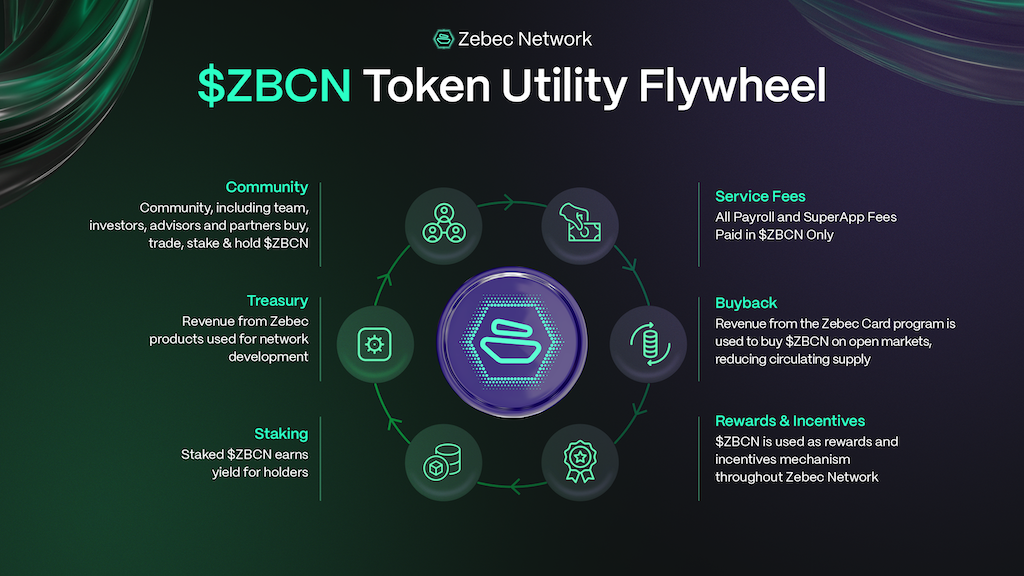
The integration of ZBCN into the SuperApp creates a self-reinforcing economic model that aligns product growth with token utility.
As the Zebec platform expands, more users and businesses interact with SuperApp services such as payroll, payments, cards, and partner integrations. Because platform fees are paid in ZBCN, increased usage naturally generates demand for the token.
At the same time, revenue generated across Zebec products contributes to a token buyback program, which purchases ZBCN from the market on a regular cadence. These buybacks link real-world product revenue with token supply dynamics.
The result is a simple but powerful cycle:
More product usage → more fees paid in ZBCN → buybacks funded by platform revenue → stronger ecosystem alignment.
As adoption grows across both retail and enterprise users, this flywheel reinforces the connection between the success of Zebec’s products and the role of ZBCN within the network.
A Token Built Around Real Utility
The Zebec SuperApp is designed to unify financial tools that traditionally exist across separate platforms. ZBCN provides the connective layer that links those services together—supporting access, governance, incentives, and ecosystem growth.
As the SuperApp expands through mobile releases, enterprise deployments, and additional integrations, ZBCN will continue to function as the economic backbone of the platform, aligning the interests of users, partners, and the broader Zebec community.
Other Articles